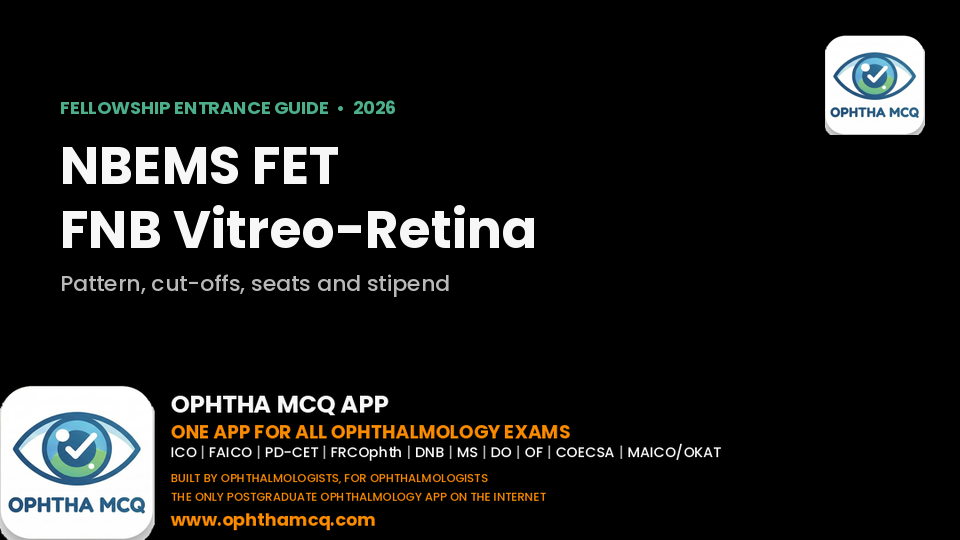
NBEMS FET FOR FNB VITREO-RETINAL SURGERY: PATTERN, CUT-OFFS, SEATS, STIPEND AND HOW TO PREPARE
For an ophthalmologist who wants a structured, two-year vitreo-retina training programme recognised by NBEMS, the route is the Fellowship Entrance Test, or FET. In ophthalmology, the FET leads to one course: FNB Vitreo-Retinal Surgery.
This guide covers the exam pattern, marking, past cut-offs, seats, stipend, fees and counselling, along with a preparation plan.
To start practising vitreo-retina and general ophthalmology MCQs now, the Fellowship Entrance MCQs course on Ophtha MCQ is here: https://www.ophthamcq.com/new-courses/92-fellowship-entrance-mcqs-%7C-ophtha-mcq
WHAT IS FNB VITREO-RETINAL SURGERY
FNB stands for Fellow of National Board. FNB Vitreo-Retinal Surgery is a two-year, full-time fellowship run at NBEMS-accredited hospitals. Admission is only through the FET and NBEMS's centralised merit-based counselling.
ELIGIBILITY
• A recognised MS or DNB in Ophthalmology, the only feeder qualification for this course
• The degree or provisional pass certificate must be obtained by the cut-off date set in that year's bulletin. For the last cycle, it was 31 December 2025.
• Registration with the NMC or a State Medical Council
• No upper age limit
THE EXAM PATTERN
• One computer-based paper of 100 MCQs in 105 minutes
• Part A: 40 questions from general ophthalmology, the feeder specialty, in 45 minutes, carrying 40% weightage
• Part B: 60 questions from vitreo-retina at entry level, in 60 minutes, carrying 60% weightage
• Marking: +4 for a correct answer, -1 for a wrong answer, 0 for unanswered
• Maximum score: 400
Vitreo-Retinal Surgery has its own paper and is not clubbed with any other fellowship. So Part A is entirely general ophthalmology and Part B is entirely vitreo-retina.
HOW THE NEGATIVE MARKING WORKS IN YOUR FAVOUR
With four options and +4/-1 marking, a pure guess has an expected value of +0.25 marks: a 1 in 4 chance of +4 against a 3 in 4 chance of -1. Rule out one option and the expected value rises to +1. Rule out two and it rises to +1.5.
So if you can eliminate even one option with confidence, attempting the question is the better bet. That is why MCQ practice matters so much for the FET: it trains you to eliminate wrong options quickly.
QUALIFYING CUT-OFF
Candidates who score at or above the 50th percentile in their own paper qualify. The same percentile applies to every category, and there is no re-evaluation.
Vitreo-retina cut-off scores at the 50th percentile, out of 400:
• FET 2023 (exam on 3 March 2024): 237
• FET 2024 (exam on 23 February 2025): 247
• FET 2025 (exam on 14 March 2026): 234
Because the cut-off is a percentile, it changes every year with the number and strength of candidates. It is the score half of the candidates reached, not a pass mark to aim for. Seats are limited, so a competitive rank needs a score comfortably above the cut-off. A target of around 260 or more gives you a margin.
In FET 2025, NBEMS reviewed every question after the exam and found 17 questions across specialties to be technically incorrect or ambiguous. Every candidate was given full marks for those questions.
SEATS: 2025 ADMISSION SESSION
In Round 1 of counselling for the 2025 session, 13 vitreo-retina seats were offered at 8 hospitals:
• Army Hospital (Research and Referral), Delhi Cantt: 2 seats
• Sir Ganga Ram Hospital, New Delhi: 1 seat
• Kashyap Memorial Eye Hospital, Ranchi: 1 seat
• Ahalia Foundation Eye Hospital, Palakkad: 2 seats
• Chaithanya Eye Hospital, Thiruvananthapuram: 2 seats
• National Institute of Ophthalmology, Pune: 1 seat
• Tibra Eye Hospital and Retina Centre, Sikar: 3 seats
• Netrodaya The Eye City, Varanasi: 1 seat
Seats have grown from 9 in the 2023 session to 13 in 2025. Many seats also stay unfilled: 8 vitreo-retina seats were still vacant in the final mop-up round of the 2025 session. A qualified candidate who is flexible about location has a realistic chance of a seat.
STIPEND, FEES AND BOND
• Minimum stipend: ₹49,000 a month in year 1 and ₹51,000 a month in year 2, under NBEMS guidelines effective 1 June 2025. Hospitals may pay more, and some do.
• Course fee: ₹1,25,000 a year, made up of tuition, library, annual appraisal and accommodation charges. The accommodation part applies only if the hospital provides accommodation.
• How it is paid: NBEMS collects the first-year fee at counselling, and you pay later years directly to the hospital.
• Bond: NBEMS has no blanket bond for vitreo-retina. A hospital may impose a service bond only if it declares it in the counselling seat matrix, so check the matrix before choosing.
HOW COUNSELLING WORKS
NBEMS publishes a separate merit list for each specialty and runs centralised online counselling over several rounds, ending with a mop-up round. In each round, you either accept and freeze your seat, which ends your participation, or accept and request an upgrade. You must pay the fee and join by the deadline. Admission is also subject to a medical fitness check by the hospital.
WHEN IS THE NEXT FET
As of 31 October 2026, NBEMS has not announced a date, application window or information bulletin for the next FET.
In past cycles, applications opened in January and the exam was held in February or March. The last application window ran only about three weeks, from 14 January to 3 February 2026. Check natboard.edu.in regularly from January, and keep your PG certificate, medical council registration and Aadhaar ready.
WHAT TO STUDY
Part B (60 questions) covers vitreo-retina clinical practice and the basic sciences applied to it. High-yield areas include:
• Diabetic retinopathy and diabetic macular oedema
• Age-related macular degeneration and anti-VEGF agents
• Retinal vein and artery occlusions
• Posterior vitreous detachment, retinal breaks and retinal detachment
• Proliferative vitreoretinopathy, macular hole and epiretinal membrane
• Vitrectomy instrumentation, tamponade agents and intraoperative complications
• Retinopathy of prematurity and inherited retinal disease
• Imaging: OCT, fundus fluorescein angiography, ICG, B-scan and electrophysiology
• Posterior uveitis and infectious retinitis
Standard books: Ryan's Retina, BCSC Retina and Vitreous, and Whitcup and Nussenblatt's Uveitis.
Part A (40 questions) covers general ophthalmology across glaucoma, cornea, lens, uvea, neuro-ophthalmology, oculoplasty, paediatrics, strabismus and optics. Kanski's Clinical Ophthalmology and Parsons' Diseases of the Eye are the foundation, along with the standard book for each subspecialty.
Part B carries 60% of the marks, so give it most of your time. Don't neglect Part A, though: 40 questions at +4 each is 160 marks.
A PREPARATION PLAN
• Now to December: work through vitreo-retina from the standard books, topic by topic, and practise MCQs after each topic.
• December to January: revise general ophthalmology for Part A, with MCQs across every subspecialty.
• Once the bulletin is out: practise full 100-question sets in 105 minutes, and track your Part A and Part B scores separately.
• Throughout: practise attempting questions where you can eliminate options, rather than leaving them blank.
The Fellowship Entrance MCQs course has vitreo-retina and general ophthalmology question sets built from these standard books: https://www.ophthamcq.com/new-courses/92-fellowship-entrance-mcqs-%7C-ophtha-mcq
HOW OPHTHA MCQ HELPS
The Fellowship Entrance MCQs course on Ophtha MCQ is built for ophthalmology fellowship entrance exams, including the FET.
• Retina and vitreous MCQs for Part B
• General ophthalmology MCQs across uvea, cornea, glaucoma, lens, oculoplasty, paediatrics and strabismus, and neuro-ophthalmology for Part A
• Applied basic sciences: physiology, biochemistry, immunology, pharmacology and pathology
• Questions written fresh from the standard books
• Written by ophthalmologists who have cleared fellowship entrance exams themselves
Built by ophthalmologists, for ophthalmologists.
Start your FET preparation today: https://www.ophthamcq.com/new-courses/92-fellowship-entrance-mcqs-%7C-ophtha-mcq