Fellowship Entrance MCQs | Ophtha MCQ

Description

Fellowship Entrance MCQs | Ophtha MCQ
Built by ophthalmologists, for ophthalmologists who have actually cracked these exams

Your fellowship seat is decided by an MCQ paper

After MS, DNB or DO, the next step is a fellowship, and most fellowship seats are decided by a written MCQ test. Leading eye hospitals such as Sankara Nethralaya, Dr. Shroff’s Charity Eye Hospital, Sadguru Netra Chikitsalaya, Narayana Nethralaya and Giridhar Eye Institute run their own entrance tests. NBEMS runs the FET for FNB Vitreo-Retinal Surgery. These papers go deeper than PG exams, and general PG question banks weren’t written for them.

This course was. It’s written by ophthalmologists who have cleared fellowship entrance exams themselves.

What’s inside

Subspecialty-wise MCQs

  • Retina and vitreous
  • Uvea
  • Cornea and external disease
  • Glaucoma
  • Lens and cataract
  • Oculoplasty and orbit
  • Paediatric ophthalmology and strabismus
  • Neuro-ophthalmology
  • Clinical scenarios

Applied basic sciences
Physiology, biochemistry, immunology, pharmacology and pathology, all as they apply to ophthalmology. Fellowship papers test the science behind the clinical picture, and this is where many candidates lose easy marks.

Written from the standard books

Every question is written fresh, not copied, and mapped to the standard books for each subspecialty.

Retina and vitreous

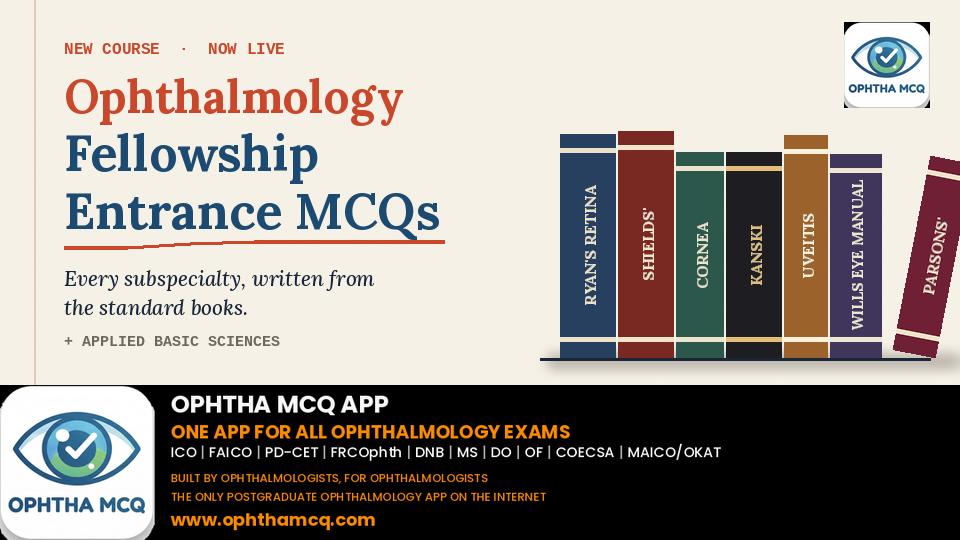
  • Ryan’s Retina: the definitive reference for medical retina, surgical retina and retinal imaging. Questions cover disease mechanisms, imaging findings and surgical principles at fellowship depth.
  • BCSC Retina and Vitreous: the AAO’s concise, exam-oriented section. It covers the core concepts and classifications that MCQs test most often.

Uvea

  • Whitcup and Nussenblatt’s Uveitis: the standard text for uveitis. It covers classification, the immunology behind each entity, infectious and non-infectious uveitis, and treatment protocols.

Cornea and external disease

  • Cornea: the two-volume gold-standard reference, now in its 6th edition. It covers corneal dystrophies, infections, ocular surface disease, keratoplasty and refractive surgery.

Glaucoma

  • Shields’ Textbook of Glaucoma: the classic glaucoma text. It covers angle anatomy, the mechanisms of each glaucoma type, investigations and medical and surgical management.

Oculoplasty and orbit

  • Smith and Nesi’s Ophthalmic Plastic and Reconstructive Surgery: the most comprehensive single reference for eyelid, lacrimal, orbital and reconstructive surgery.
  • BCSC Oculofacial Plastic and Orbital Surgery: the AAO section for anatomy, orbital disease and the classifications that turn up in MCQs.

Paediatric ophthalmology and strabismus

  • Taylor and Hoyt’s Pediatric Ophthalmology and Strabismus: the leading reference for paediatric eye disease, retinopathy of prematurity, genetic disorders and strabismus.
  • Strabismus Simplified: a widely used Indian text that explains ocular motility, squint types and their management clearly, which makes it high-yield for strabismus questions.

General ophthalmology and clinical foundation

  • Kanski’s Clinical Ophthalmology: the systematic, image-rich clinical reference across every subspecialty. It’s the backbone for clinical recognition questions.
  • Parsons’ Diseases of the Eye: the standard Indian textbook, covering fundamentals and the basic sciences of ophthalmology.
  • The Wills Eye Manual: the go-to manual for clinical diagnosis and management. It’s the source for the case-based clinical scenario questions.

How it helps you

  • You revise from the standard books without reading all of them. The high-yield points from each textbook are turned into MCQs.
  • You prepare one subspecialty at a time. Practise the subspecialty you’re applying for in depth, then revise general ophthalmology across the rest.
  • You cover the basics properly. Applied basic sciences are included, not skipped.

Why an ophthalmology-only course
Generic super-speciality and PG platforms spread across dozens of subjects. Ophtha MCQ covers one: ophthalmology. Every question and explanation is written by ophthalmologists, for ophthalmologists, and built for fellowship entrance.


Why Ophtha MCQ
Ophtha MCQ is an ophthalmology-only platform with a course built specifically for fellowship entrance preparation. Generic super-speciality and PG platforms spread across dozens of subjects. Every question and explanation here is written by ophthalmologists, for ophthalmologists.

Who it’s for

  • MS, DNB and DO ophthalmology graduates applying for fellowships
  • Final-year residents planning their fellowship applications
  • Practising ophthalmologists moving into a subspecialty

Start your fellowship entrance preparation on Ophtha MCQ. Download the app or visit www.ophthamcq.com.

Start preparing on Ophtha MCQ. Download the app or visit www.ophthamcq.com.

Content

CORNEA AND REFRACTIVE SURGERY

Folder

Quiz
Pediatric

Folder

Quiz

Retina And Vitreous

Folder

Quiz

Uveitis

Folder

Quiz

Neuro Ophthalmology

Folder

Quiz

Oculoplastic

Folder

Quiz

GLAUCOMA LENS & ANT CHAMBER

GLAUCOMA LENS & ANT CHAMBER

Folder

FAICO EXAM BY AIOS COMPLETE QUESTION BANK FOR OPHTHALMOLOGISTS Preparing for the FAICO Examination by All India Ophthalmological Society? The OPHTHA MCQ App is built for ophthalmology residents
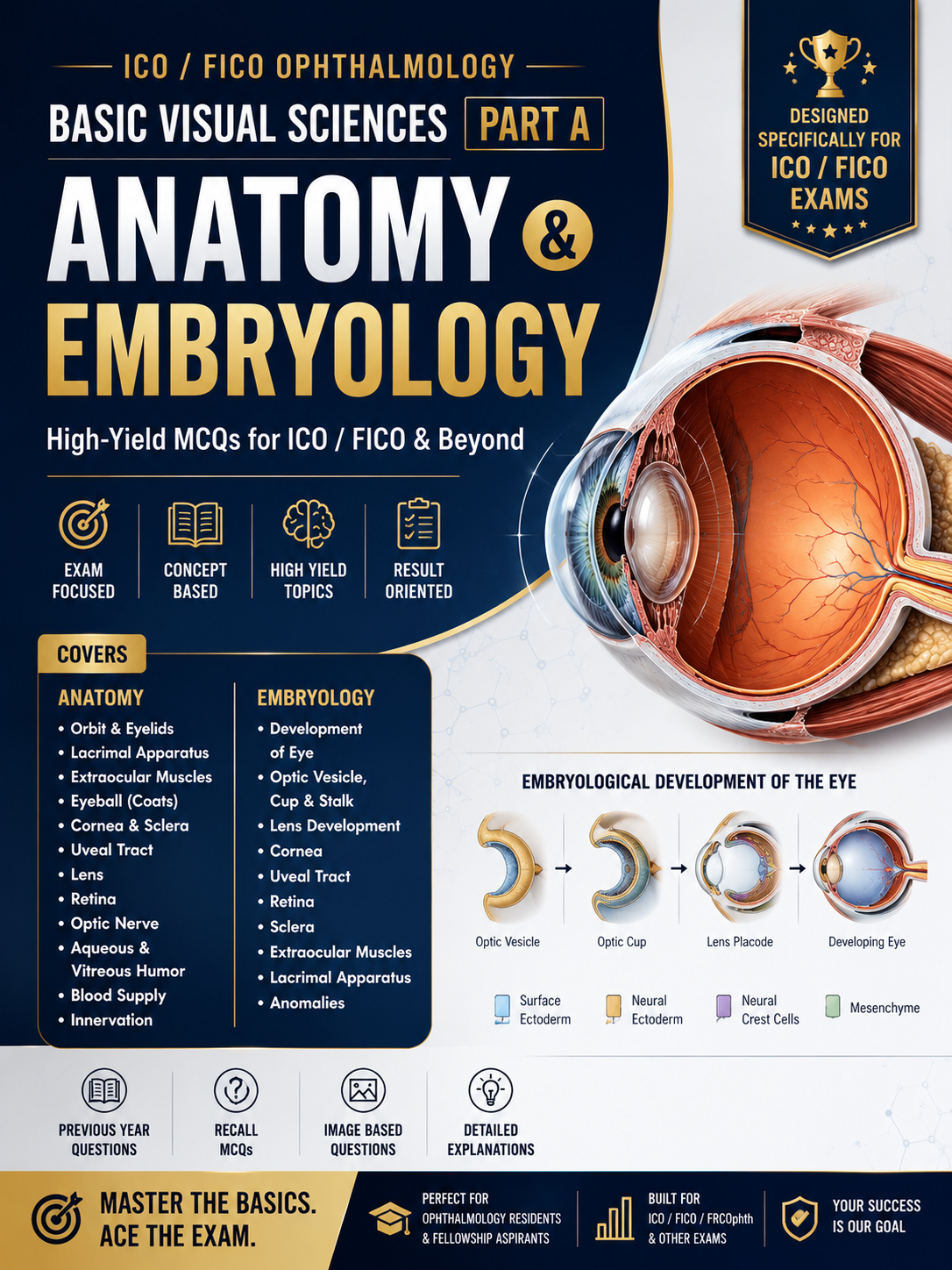
ANATOMY & EMBRYOLOGY

ANATOMY & EMBRYOLOGY

Folder

Fellowship Entrance MCQs | Ophtha MCQ

$10.51$15.0331% off
Have a coupon?

Member Reviews

What our members are saying about this course

No testimonials yet.

$10.51